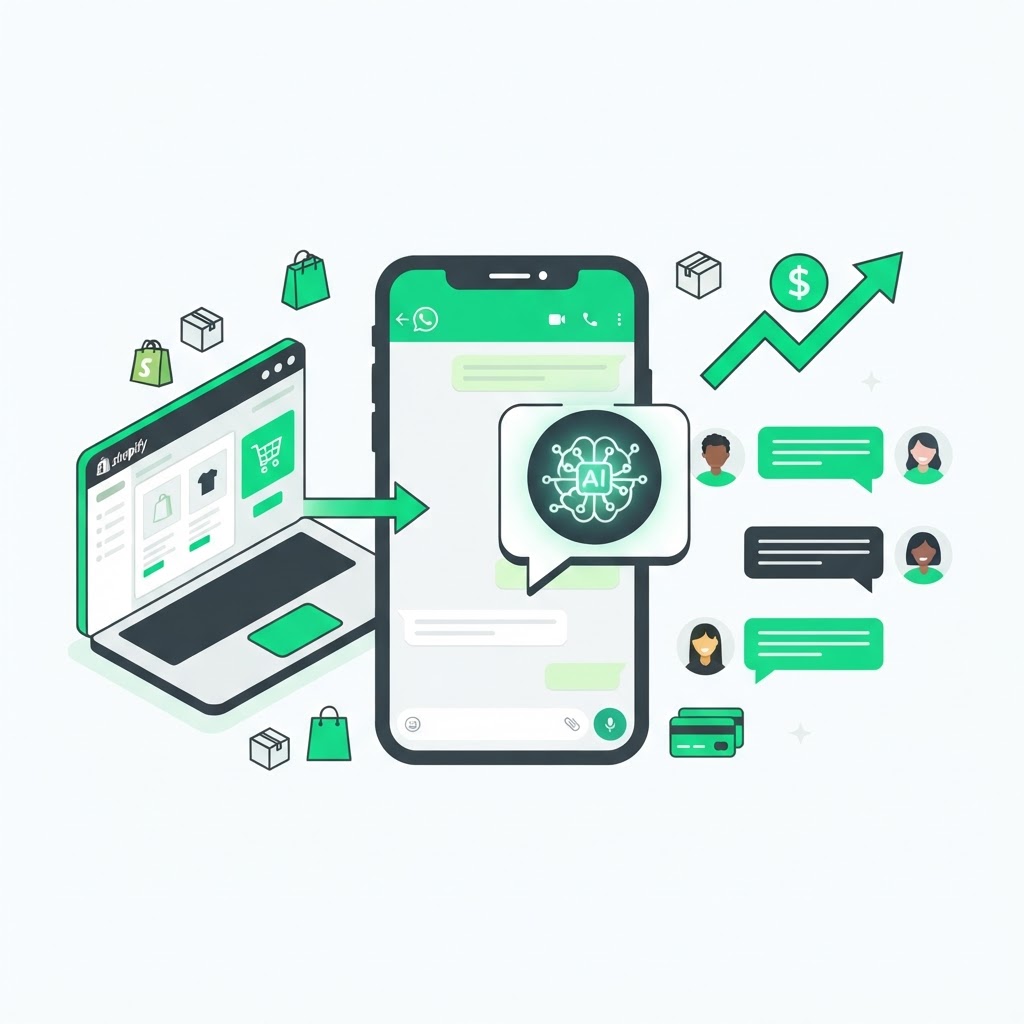
Scaling Support: Implementing an AI Ecommerce Assistant on WhatsApp for Shopify
In the competitive landscape of Shopify ecommerce, the difference between a one-time buyer and a loyal customer often comes down to responsiveness. Manual support teams simply cannot keep pace with instant-messaging expectations, and every unanswered question is a potential lost sale. An AI ecommerce assistant for WhatsApp changes that equation by turning your store's most-used channel into a 24/7 sales and support engine.
Why WhatsApp AI Agents Matter for Shopify Growth
WhatsApp has become the preferred communication channel for billions of consumers, and shoppers increasingly expect brands to meet them there rather than in a separate help-desk portal. By integrating an AI agent into your store, you can automate routine tasks such as checking order status, answering product questions, and sending proactive updates in real time. This is not just about automation; it is about delivering a personalized shopping experience that feels like a premium boutique rather than a faceless support queue.
The channel also closes the gap between discovery and purchase. A customer who messages "Is this still in stock?" wants an answer in seconds, not hours. When that answer comes from an AI ecommerce assistant connected directly to your product catalog, you remove the friction that normally causes shoppers to abandon the conversation entirely.
Boosting Efficiency with an AI Ecommerce Assistant
With StoreAgent, Shopify merchants can bridge the gap between their backend systems and their customers' favorite messaging app. Unlike static chatbots that rely on rigid decision trees, this kind of AI agent leverages live context from your store's database to provide accurate, helpful answers without human intervention. From handling "Where is my order?" queries to flagging low-stock items before they sell out, the assistant effectively acts as a tireless store manager.
Because the agent reads real order and inventory data instead of guessing, it avoids the frustrating "I don't understand" loops that make traditional chatbots feel useless. Customers get consistent, correct answers whether they message at 9 a.m. or 2 a.m., and your human team only steps in for genuinely complex cases.
Key Benefits for Shopify Merchants
An AI ecommerce assistant on WhatsApp delivers measurable operational value, not just a nicer chat experience. The main advantages include:
- Real-time inventory visibility: The assistant can confirm stock levels, notify customers when a backordered item ships, and sync status updates without manual lookups.
- Personalized shopping experiences: By referencing a customer's past orders or browsing behavior, the agent can suggest complementary products, which tends to lift average order value.
- Instant order tracking: Automated, accurate shipping updates reduce the volume of repetitive "where is my package" tickets reaching your support inbox.
- Lower response-time pressure on staff: Routine questions get resolved instantly, freeing your team to focus on escalations and relationship-building conversations.
These benefits compound over time. As the assistant handles a larger share of first-contact questions, your support team's workload shifts from reactive firefighting to proactive customer care.
Recovering Revenue, Not Just Tickets
Support automation is only half the story. The same WhatsApp infrastructure that answers questions can also recover abandoned carts, since the AI agent already has access to checkout data and customer messaging history. Instead of a generic email that gets ignored, the shopper receives a conversational nudge on the channel they actually check throughout the day.
This is the core idea behind CartKeeper AI: pairing cart-recovery messaging with the same assistant that handles support, so every conversation is an opportunity to either solve a problem or close a sale. A merchant does not need two separate systems — one for support, one for recovery — when a single AI agent can do both without confusing the customer experience.
Getting Started with Implementation
Integrating an AI ecommerce assistant does not require deep coding knowledge if you use the right infrastructure. By connecting your Shopify store to an intelligent agent, you ensure that every WhatsApp message contributes to your sales funnel rather than just clogging up a shared inbox.
A practical rollout generally looks like this:
- Connect your Shopify product and order data so the assistant always answers from live information, not stale exports.
- Define the handful of use cases you want automated first — order status, stock checks, and basic FAQs are usually the highest-impact starting point.
- Set clear handoff rules so complex or sensitive conversations route to a human agent without the customer having to repeat themselves.
- Test the assistant with real order scenarios before opening it to your full customer base.
Developers who want more control over the messaging layer itself, rather than a fully packaged solution, can look at Wasmer, a WhatsApp middleware built for teams that need to customize how AI agents connect to their store's systems.
Measuring Impact and Optimizing Over Time
Once the assistant is live, treat it like any other growth channel: track what's working and adjust. Watch ticket deflection rate, response time, and how often conversations lead to completed orders rather than dead ends. If a particular question type keeps getting escalated to humans, that's a signal the assistant needs more context or a clearer answer path.
It also helps to connect support performance with broader marketing data. Tools like the AI marketing audit can show how traffic from Google Ads, GA4, and Search Console behaves once it reaches your store, helping you see whether WhatsApp support and recovery are actually improving conversion downstream. For more implementation ideas and case-style walkthroughs, the CartKeeper blog is a good next stop.
FAQ
Does an AI ecommerce assistant replace my human support team?
No. It handles repetitive, high-volume questions like order status and stock checks, freeing your team to focus on complex or sensitive cases that genuinely need a person.
Will customers know they're talking to an AI agent?
Best practice is to be transparent about it. Most customers accept AI assistance readily when it gives them fast, accurate answers and an easy path to a human when needed.
Can the same assistant handle both support and abandoned cart recovery?
Yes, and it's more effective that way. Since the agent already has access to order and checkout data, it can answer a support question and follow up on an abandoned cart in the same conversational thread.
Ready to turn WhatsApp into a 24/7 support and recovery channel for your Shopify store? Visit CartKeeper AI to see how it works.