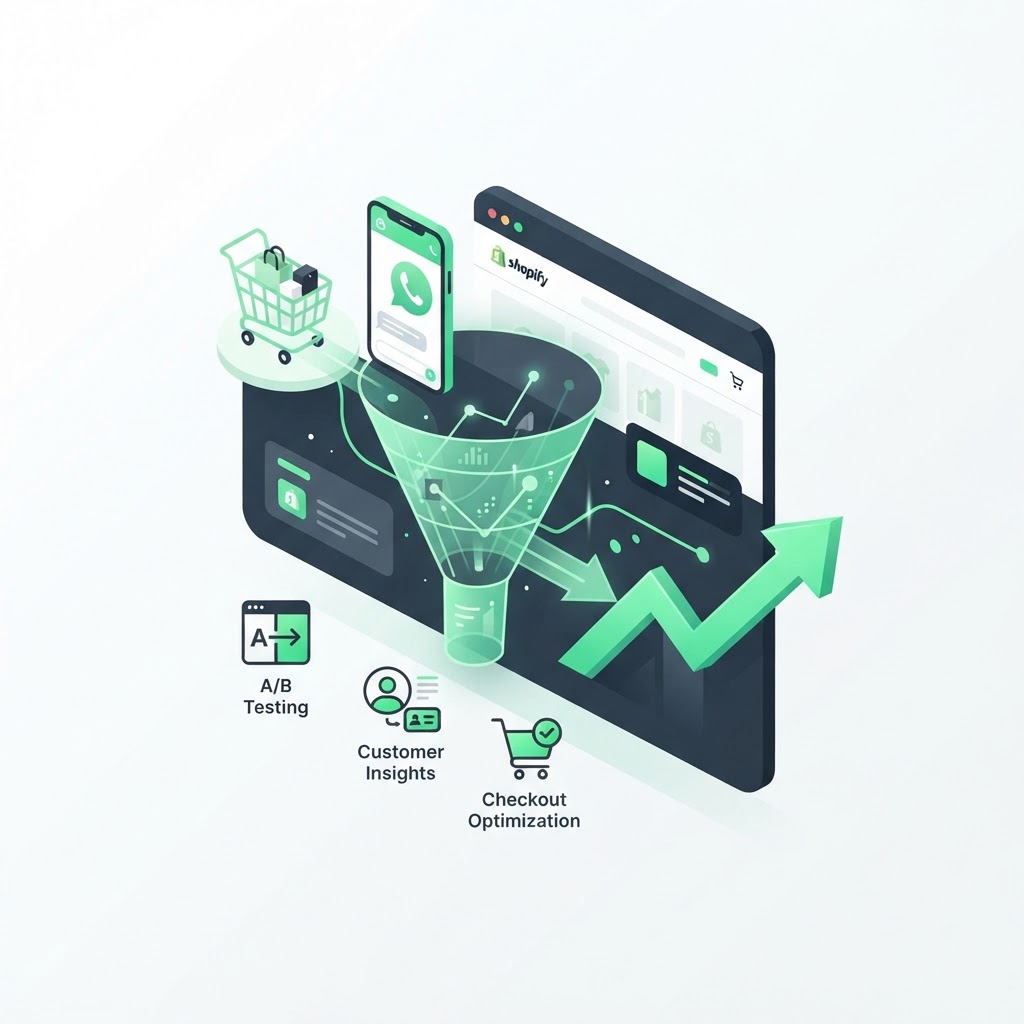
Shopify CRO Analytics: The Secret to Boosting Your Conversion Rates with AI
Shopify CRO analytics is the discipline of reading your store's data not just to report performance, but to uncover the exact reasons visitors leave without buying. Most merchants have access to the same metrics, yet very few use them to drive real decisions. With AI layered on top of your analytics stack, you can finally close the gap between "what happened" and "why it happened."
Why Shopify CRO Analytics Matters More Than Ever
Traffic is getting more expensive every year, which means squeezing more revenue out of existing visitors is often cheaper than acquiring new ones. Shopify CRO analytics gives you the visibility to find friction points in your funnel before they quietly drain your ad budget. A store that improves its conversion rate even modestly often sees a bigger impact on profit than one that doubles ad spend.
The challenge is that conversion data is scattered across Google Ads, GA4, Search Console, Shopify's native reports, and sometimes a separate email or SMS tool. Without a unified view, merchants end up optimizing one channel while ignoring bottlenecks in another.
The Problem with Traditional Analytics
Most store owners rely on standard dashboards that tell them what happened but rarely why. You see high bounce rates, but you don't know if the issue is your pricing, your checkout friction, or your ad messaging. Manual auditing of these metrics is time-consuming and prone to human error.
Traditional reporting also tends to be reactive. By the time you notice a drop in conversion rate, you've already lost a week or more of revenue. Teams often spend hours cross-referencing spreadsheets just to form a hypothesis, let alone test a fix.
How AI Transforms CRO
AI-powered tools analyze thousands of data points across your store simultaneously, something a human analyst simply cannot do at scale. By identifying patterns in user behavior, AI can pinpoint exactly where your funnel leaks, whether it's an underperforming product page, a clunky checkout flow, or a mismatch between ad creative and landing page content.
A tool like the AI marketing audit for Shopify stores connects to your Google Ads, GA4, and Search Console data to surface issues automatically. Instead of guessing which campaign is wasting budget or which page has a conversion leak, you get a prioritized list of what to fix first.
What AI Audits Typically Reveal
- Mismatched search intent between keywords and landing pages
- Campaigns driving traffic to pages with high exit rates
- Tracking gaps that silently distort your reported conversion rate
- Underused high-intent pages that could be promoted further
Key Metrics to Track
To truly master CRO, you must look beyond basic traffic numbers and sessions. The metrics below give a much clearer picture of funnel health:
- Add-to-cart ratio: Are your product pages persuasive enough to move visitors toward a purchase decision?
- Checkout completion rate: Is there friction at payment, shipping cost reveal, or account creation steps?
- Cart abandonment rate: How many shoppers add items but never return to finish the order?
- Customer Lifetime Value (CLV): Are your marketing efforts bringing in high-quality, repeat customers or just one-time bargain hunters?
- Time to first response: How quickly do you re-engage a shopper after they leave without buying?
Tracking these together, rather than in isolation, is what separates a reactive store from one that compounds growth month over month.
Turning Analytics Into Action: Recovering Lost Carts
Identifying a leak is only half the job; closing it is where revenue actually comes back. One of the most consistently high-leverage fixes is recovering abandoned carts through a channel customers actually check, rather than relying solely on email that often goes unread.
This is where conversational recovery tools make a measurable difference. A WhatsApp-based recovery flow can re-engage a shopper minutes after they abandon checkout, answer their questions in real time through an AI store agent that responds on WhatsApp, and guide them back to complete the purchase without manual follow-up from your team.
A Simple Framework to Apply Your CRO Data
- Audit first. Use your analytics to identify the top three pages or steps causing the most drop-off.
- Segment the cause. Determine whether the issue is pricing, trust signals, shipping costs, or simple distraction.
- Automate the fix. Deploy targeted recovery messaging, like a WhatsApp follow-up, for the specific abandonment reason you identified.
- Measure the delta. Compare recovery rates before and after the change over a comparable time window.
- Iterate monthly. CRO is not a one-time project; it's a recurring cycle of small, compounding improvements.
For developers building custom recovery flows or integrating messaging into existing store systems, the WhatsApp middleware for developers provides the infrastructure to connect AI agents directly to customer conversations.
Take Control of Your Store's Growth
Stop leaving money on the table by relying on dashboards that only describe the past. By leveraging AI audit tools alongside conversational recovery, you can turn your store into a system that actively repairs its own leaks instead of just reporting them.
The merchants who win at Shopify CRO analytics are the ones who treat data as a trigger for action, not just a monthly report. Pair your audit insights with automated recovery, and the same traffic you're already paying for starts converting at a noticeably higher rate.
FAQ
What is Shopify CRO analytics exactly?
It's the practice of analyzing store and marketing data, such as Google Ads performance, GA4 behavior flow, and Search Console queries, to find specific reasons visitors don't convert. The goal is pinpointing actionable fixes, not just tracking vanity metrics like total sessions.
How does AI improve conversion rate optimization compared to manual analysis?
AI can process far more data points than a human analyst in a fraction of the time, surfacing patterns like mismatched ad-to-landing-page intent or hidden tracking gaps. This lets merchants prioritize fixes based on actual impact rather than guesswork or intuition.
Can WhatsApp recovery actually improve my conversion rate?
Yes, because it reaches customers on a channel they check far more consistently than email, and it allows real-time answers to objections like shipping costs or product questions. Combining this with CRO data lets you target the exact abandonment reasons instead of sending generic reminders.
Ready to find your store's conversion leaks and start recovering lost revenue automatically? Explore how CartKeeper AI can help at cartkeeper.co.